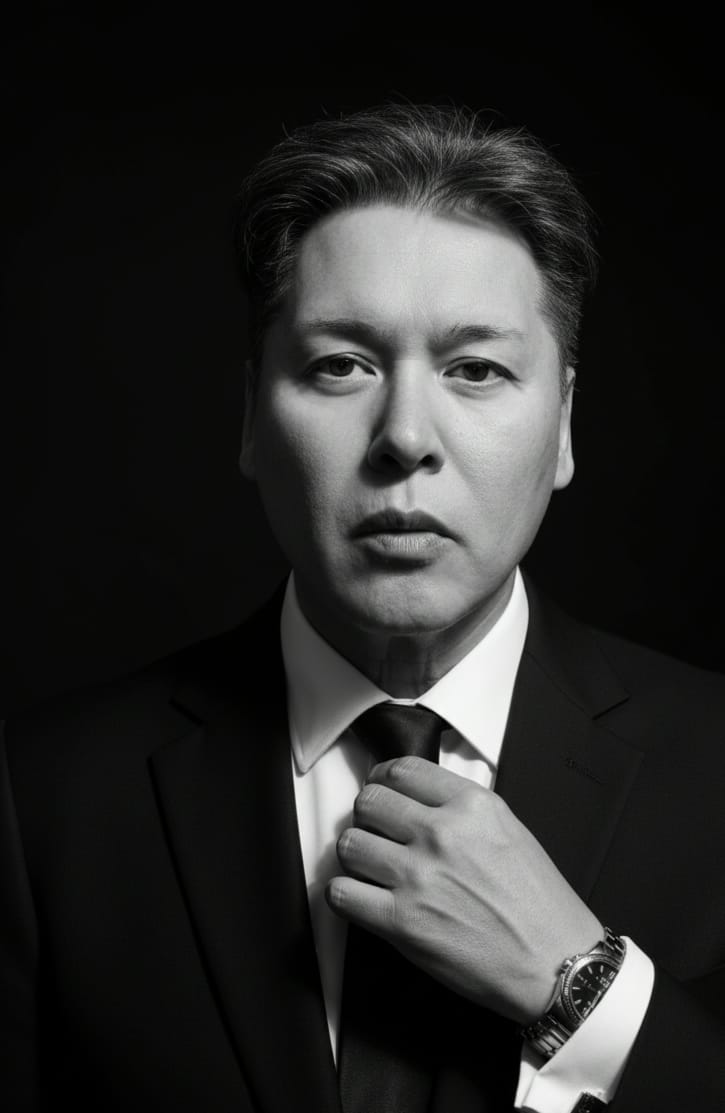
Jérôme Vetillard
VP R&D & Chief Product Officer · Qualees · Founder · Twingital Institute
PhD / MD / Global Executive MBA / MIT Sloan CPO Program / Engineer AgroParisTech "Bioprocess Engineering"
Positioning
I
Complex systems engineering
PhD Biotechnology · 20 years of industrial-scale systems architecture · Digital twins
II
Specialised clinical medicine
Haematology-oncology · Cell therapy · Radiopathology · Nuclear Medicine · Genetic engineering
III
Product strategy in regulated environments
Global Executive MBA IE/Brown · MIT CPO Program · Healthcare & Life Sciences · MDR · EU AI Act
What is rare in this positioning is not each of these three dimensions separately — it is their coexistence within a single trajectory. Most experts in medical AI have a computer science background and a superficial medical exposure. Most clinicians interested in AI lack the training of a systems architect. Most product strategists in healthcare lack doctoral-level scientific training.
This intersection is not a communication stance — it is the result of a non-linear trajectory, built over twenty years, at the convergence of disciplines that rarely speak to one another.
A high-performing AI system is not yet a deployable system. The real work lies between those two states.
20
years · Microsoft
Healthcare & Life Sciences
€148M+
licences under
management
4
paying POCs
TweenMe
€3.5M
target budget
PREDICARE
Top 5%
ISPOR Glasgow 2025
Smart Data Fertilizer
Education
The educational trajectory is deliberately pluridisciplinary — spanning domains that do not spontaneously communicate with one another, and whose combination is the foundation of the Twingital Institute's approach.
Scientific & engineering training
Engineer — AgroParisTech
Biotechnology option · Industrial bioreactors · Modelling of complex biological systems
PhD in Biotechnological Engineering — AgroParisTech
13th ENS Ulm national competitive entrance examination
Specialised medical training
Haematology-Oncology
Clinical oncology · Cell therapy · Stem cells
Nuclear Medicine · Radiopathology · Radiation Protection
Treatment of acute radiation syndrome (haematopoiesis, GI barrier, inflammatory storm)
Genetic engineering
Molecular foundations · Clinical applications
Management & strategy
Global Executive MBA — IE Business School / Brown University
Business acumen · Business model design · Go-To-Market strategy · International leadership
Chief Product Officer Program — MIT Sloan
Ongoing · GVI/PCI frameworks · Industrial-scale product strategy
Advanced specialisations
Artificial Intelligence & Machine Learning
Deep neural networks (AutoEncoder, CTGAN, temporal transformers, xLSTM, GRU…) · Digital twins · Synthetic data generation · HDLSS
AI regulation in healthcare
EU AI Act · MDR/IVDR · HDS · GDPR · FHIR/HL7 interoperability
20 years at Microsoft
Twenty years at Microsoft — from Global Solution Architect (Business Productivity complex systems) to Principal Enterprise Architect (S500 segment, Microsoft's 500 global strategic accounts), from Senior Digital Advisor (Regulated Industries) to Senior Industry Advisor Healthcare & Life Sciences — provided something rare: intimate, first-hand knowledge of how large organisations deploy — or fail to deploy — technology systems at scale in regulated environments. This is not theoretical knowledge. It is knowledge earned on real programmes, with real budgets, real constraints and real failures.
Senior Industry Advisor — Healthcare & Life Sciences (CPO)
Strategic advisory in regulated industries
Microsoft · Healthcare & Life Sciences
Advisory to C-suite executives (CIO, CDO, CPO, CEO) on technology and AI strategy in healthcare and life sciences environments. Architecture of digital transformation programmes at the scale of major pharmaceutical groups and hospital networks.
Senior Digital Advisor — Regulated Industries (CDO)
Digital transformation strategy
Microsoft · Regulated Industries
Leading digital transformation programmes in environments with strong regulatory constraints. Management of Azure programmes exceeding €148M in licences and €28M in services. Design of sovereign cloud architectures for public sector organisations and regulated industries.
Principal Enterprise Architect (CTO)
Enterprise architecture · S500 segment
Microsoft
Technical architecture design for Microsoft's 500 global strategic accounts. Alignment of architectural decisions with business, regulatory and organisational constraints. Primary interlocutor at CTO/CIO level.
Global Solution Architect — Business Productivity
Solution architecture at global scale
Microsoft
Design and deployment of solutions for multi-site organisations at international scale. Building the systemic architectural approach applied to complex Business Productivity systems.
Twenty years produced a central conviction: technology systems rarely fail for purely technical reasons. They fail because the organisational architecture was not ready, because governance was not defined, because regulatory constraints were ignored until the last moment. That insight is the founding premise of the Twingital Institute.
More recently, the AI surge has added a further layer of complexity — and risk. Under the commercial pressure of large technology vendors, a number of critical gaps have spread: a profound misunderstanding of what AI actually is, rushed adoption without clearly defined ROI-proven use cases, uncontrolled cost models, and a collective blind spot on legal, organisational and IT dimensions. The prerequisites for real scale-up are overlooked. SLAs, cybersecurity, redundancy and resilience are sacrificed for the supposed benefit of algorithmic performance — itself defined in vague, non-consensual terms, rarely connected to a business indicator that would make sense to the organisation deploying it.
Today
VP R&D & Chief Product Officer · Qualees
At Qualees, the remit covers product strategy, R&D architecture and the management of research programmes around TweenMe — the first universal DIY digital twin generator. This includes leading PREDICARE (a territorial predictive medicine programme, €3.5M target, BPI France pre-validation and GHT) and four paying TweenMe POCs in real operational environments.
Scientific recognition of this work was notably achieved through a top 5% poster ranking at ISPOR Glasgow 2025 — the international pharmacoeconomics conference — for TweenMe's Smart Data Fertilizer algorithm applied to a lung oncology therapeutic trial.
Founder & Director · Twingital Institute
The Twingital Institute is the think tank founded to document, formalise and disseminate the doctrine of AI industrialisation in regulated systems. It produces the RAISE Framework, research publications (including the 110-page PREDICARE Memoir v3), doctrinal positions on open questions (energy, sovereignty, governance), and cross-disciplinary explorations (The Polymath's Corner).
It also serves as the hub of a network of institutional and industrial partners engaged on the same questions — AFCRO, LYSARC, partner GHTs, funding bodies.
Approach & philosophy
There is a fundamental tension in the AI ecosystem that is rarely named explicitly: the difference between a performant system and a deployable system. Algorithmic benchmarks measure performance under ideal conditions. They do not measure governance, traceability, resilience under degraded conditions, operator acceptability or regulatory compliance. Yet it is precisely these dimensions that determine whether a system can actually be put into production and sustained over time.
The Twingital Institute's approach begins from this tension. It does not seek to oppose algorithmic performance and deployability — it seeks to define the conditions under which both can be achieved simultaneously. The RAISE Framework is the principal instrument of this approach: five pillars (Regulatory, Accountability, Interoperability, Safety, Explainability) that structure architectural decisions from the point of design, not at the certification stage.
Regulatory compliance added at the end of a project structurally generates either non-compliant systems or prohibitive remediation costs. It must be an architectural property, not a final audit.
This philosophy is not abstract. It is applied concretely in PREDICARE — where the RAISE Framework has structured architectural decisions from day one — and in TweenMe, where MDR certification is a design constraint, not a distant objective.
Explore the work